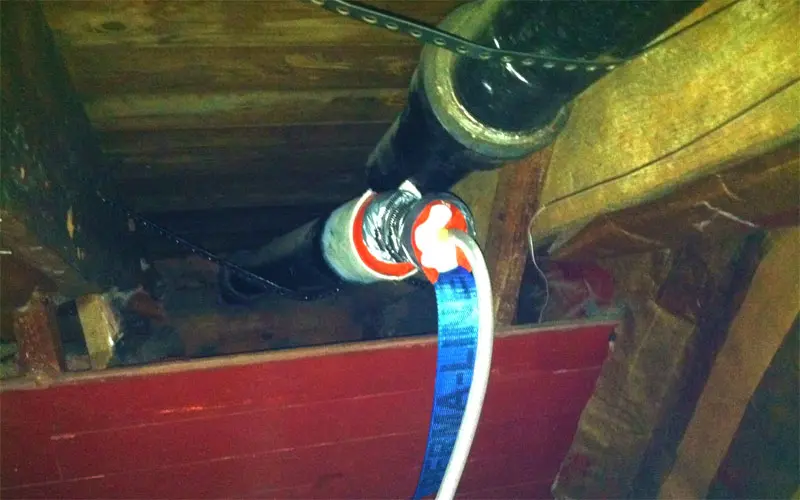
A small leak and a sewer odor near the bottom of a vertical drain line are easy to treat as minor. In an older building they are often the first visible sign of a cast iron stack that has cracked somewhere behind the walls.
Why cast iron stacks fail
Cast iron drainage piping, common in buildings from before the 1980s and many through the 1990s, corrodes from the inside out. Scale narrows the bore, and over time the wall thins and cracks. Recurring odors, staining on ceilings below bathrooms or kitchens, and slow drains on one riser point to the stack, not to a single fixture.
Start with a camera
A CCTV inspection records every crack, fracture and joint defect against its distance along the pipe, and each segment is graded on the NASSCO 1-to-5 condition scale. That shows whether the stack can be lined. A collapsed or badly deformed section cannot, and should be replaced.
Lining from the top down
Where the pipe still holds its shape, a resin-saturated liner is inverted into the stack from roof or upper-level access and cured in place into a continuous, jointless new pipe. Branch connections are reopened from inside with robotic cutters, and the finished line is camera-inspected after curing.
- A 50-year design service life, with a 10-year workmanship warranty in writing.
- Typical savings of 40 to 75 percent against excavating and replacing the same line.
- Walls, floors and finishes around the stack stay intact.