
Government & Public Sector
Infrastructure Work at Washington DC National Parks
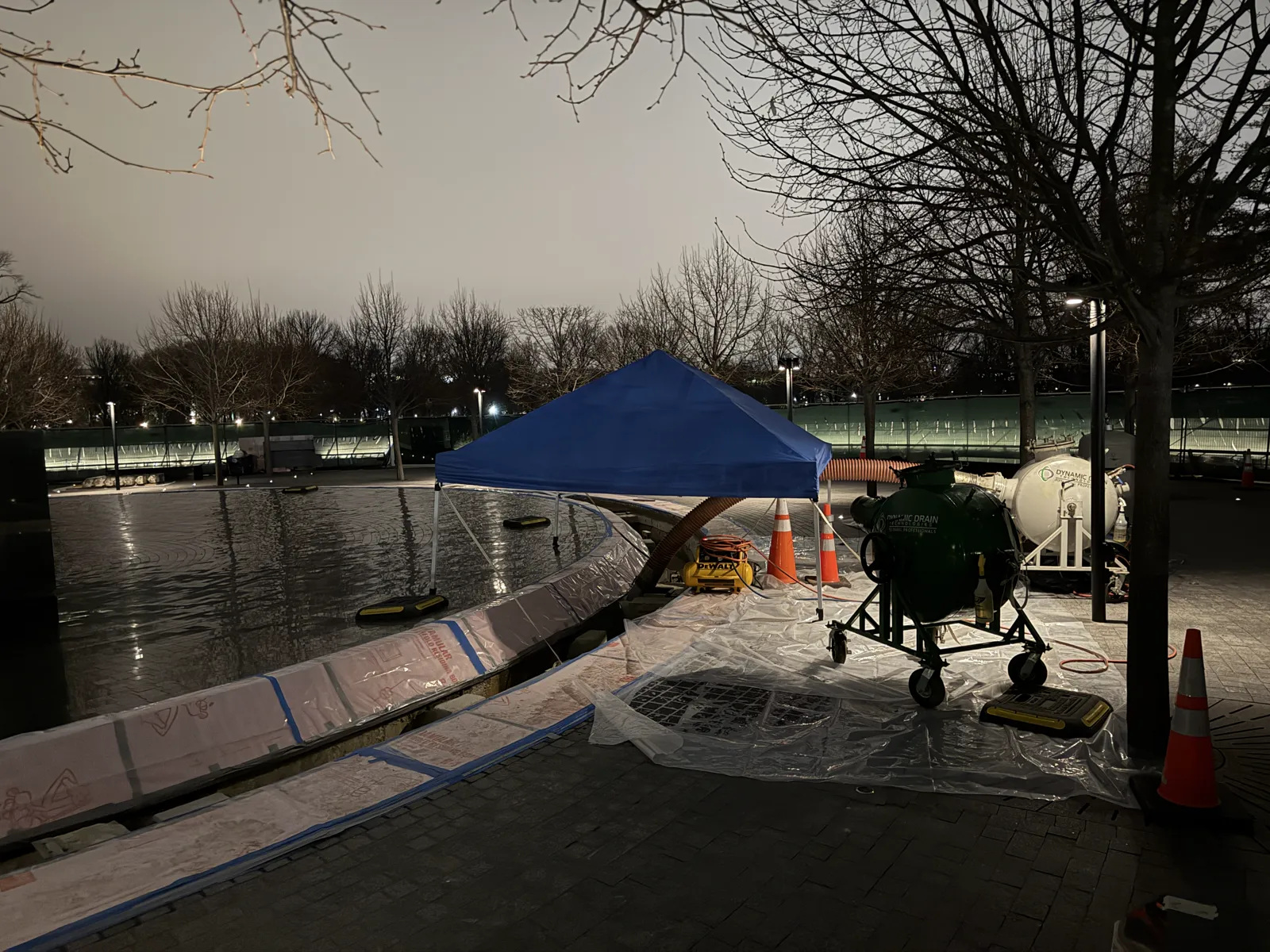
Specialist pipe evaluation and rehabilitation at four National Park Service sites in 2026, within the Service’s fountain restoration program.
The program
A Major National Park Beautification Program
In 2026 the National Park Service is restoring fountains and water features across Washington, DC, under Executive Order 14252, Making the District of Columbia Safe and Beautiful, and Executive Order 14189 for the 250th anniversary of the United States.
The Service describes the work as “modernizing mechanical systems, conserving historic stonework and sculpture, restoring landscapes and improving surrounding park amenities.” Within that wider program, Dynamic Drain performed specialist pipe evaluation and rehabilitation at four of the sites.

The sites
Four Sites, Four Scopes
01Complete
Korean War Veterans Memorial
Storm drainage, not fountain piping: 551 feet of 12 to 21 inch CIPP rehabilitation, carried out with the care a war memorial deserves. Evaluation study in January 2026, then two phases of rehabilitation in January and February.
02Complete
Freedom Plaza
Fountain and water sculpture pipe system: evaluation study in February 2026, then CIPP rehabilitation in three phases, March to May 2026.
03Complete
Columbus Plaza at Union Station
Fountain and water sculpture pipe system: evaluation study in February 2026, then CIPP rehabilitation in two phases, February and March 2026.
04In progress
Meridian Hill Park
Fountain and water sculpture pipe system: evaluation study in February 2026 and two phases of rehabilitation in March and April. A third phase was evaluated in August 2026, with rehabilitation scheduled for September.

Project poster
Korean War Veterans Memorial
The project poster: a storm GIS map of the memorial with utility vaults, manholes, cleanouts and flow directions, and the 551 feet of 12 to 21 inch CIPP rehabilitation that preserved its drainage.
The sequence
How This Kind of Work Happens
Every site followed the same sequence. Across the business roughly one in four evaluation studies leads to rehabilitation; here all four did, because the pipe condition warranted it.
- 01
Evaluation study first
Each site began with an evaluation of the pipe system, so the scope was set by what the study found.
- 02
A first phase
Rehabilitation started with a first phase, which had to prove out before the next.
- 03
Phased rehabilitation
Further phases followed as each one proved out; one site is on its third phase eight months in.
Theodore Roosevelt Island
A Second Federal Precedent
On Theodore Roosevelt Island, the 91-acre preserve in the Potomac, Dynamic Drain rehabilitated 2,000 feet of water fountain lines: 3 and 4 inch pipes feeding a 3,000-foot moat, two fountains and statues, fed by a 6 inch suction line from the river. The work was published in Cleaner magazine in March 2013, giving this page a fifteen-year arc.

Public coverage
In the News
Public coverage of the National Park Service program this work was part of.
- National Park Service, January 8, 2026Advancing Major Park Beautification and Infrastructure Improvements across Washington, D.C.nps.gov (opens in a new tab)
- National Park ServiceFountain work, National Mall and Memorial Parksnps.gov (opens in a new tab)
- National Parks Traveler, January 2026Park Service Moves Forward With Infrastructure Improvements in Washington D.C.nationalparkstraveler.org (opens in a new tab)
- WJLA ABC7, 2026DC historic fountains to be restored for America’s 250th anniversarywjla.com (opens in a new tab)
- DC News Now, 2026National Park Service begins renovations on fountains, statues at several DC parksdcnewsnow.com (opens in a new tab)
- WUSA9, 2026Union Station grant announced as Columbus Circle Fountain reopenswusa9.com (opens in a new tab)

What happens next
Start your project
Tell us more about your infrastructure challenges.
- 01Evaluation studyThe system is mapped, inspected by camera, and every section is condition-graded.
- 02Prioritized findingsGrades are weighted by system risk and turned into a plan, most critical sections first.
- 03RehabilitationTrenchless CIPP lining of the sections that matter most, without full pipe replacement. Access requirements are confirmed during the evaluation.